You started your business to build something. Somewhere along the way, you became its full-time inbox manager, scheduler, follow-up chaser, and paperwork processor.
As a result, nights and weekends absorb the work that actually grows the business — sales, strategy, key client relationships. You’re not lazy and you’re not disorganized. You’re buried.
That’s why an executive assistant is the fastest way out. But hiring one is only half the job. The other half is handing off work in a way that actually sticks — because an EA you don’t delegate to is just another person waiting on you.
Here’s how to do both.
Signs You’re Buried (Not Just Busy)
Busy is normal. Buried is when the small stuff is blocking the big stuff. You’re probably buried if:
- You spend the first hour of every day in your inbox
- Meetings get double-booked or rescheduled constantly
- Follow-ups slip and opportunities go cold
- You’re the only person who knows where things are
- You keep a running list of “things I’ll get to” that never shrinks
- Vacations mean checking email every day
If three or more of those sound familiar, you’re past the point where working harder fixes it.
Step 1: Do a One-Week Time Audit
Before you hire, find out where your time actually goes. First, for one week, jot down what you work on in 30-minute blocks. Don’t overthink it — rough notes are fine.
At the end of the week, sort every task into one of three buckets:
| Bucket | What it is | Examples |
|---|---|---|
| Only you | Work that requires your judgment, relationships, or authority | Closing deals, key hires, strategy, major client issues |
| Could be taught | Work you do because nobody else knows how | Proposals, reports, vendor coordination, CRM updates |
| Shouldn’t be you | Repetitive, low-judgment work | Scheduling, inbox sorting, data entry, travel booking, invoicing reminders |
In fact, most owners find a surprising amount lands in the bottom two buckets. After that, whatever ends up there is your EA’s job description.
Step 2: Hire for Judgment and Communication, Not Just Skills
Anyone can learn new software in a week. Judgment and communication take years. When you interview, look for someone who:
- Asks clarifying questions instead of guessing
- Writes clearly and professionally
- Can describe a time they managed competing priorities
- Has supported a busy executive or owner before
- Is comfortable speaking up when something looks off
A practical test helps. Next, give finalists a messy sample inbox or a scheduling puzzle and see how they work through it. For more interview ideas, see How to Interview and Select the Best Virtual Employee.
Virtual or in-house? Overall, for most small and mid-sized businesses, a dedicated virtual EA delivers the same support at a fraction of the cost of a local hire — without office space, equipment, or payroll overhead. We covered the growth case in Accelerate Growth with a Remote Executive Assistant.
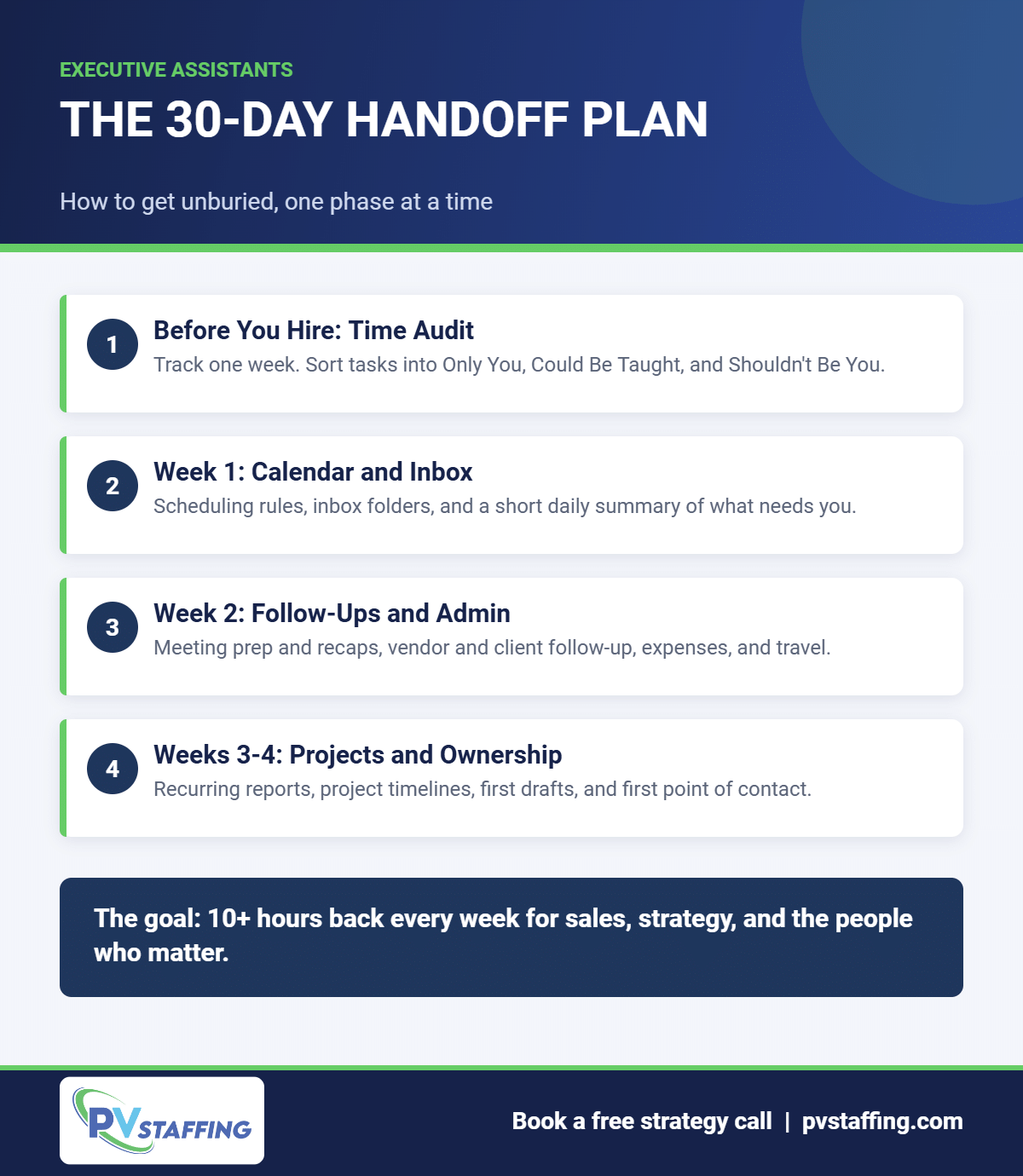
Step 3: Hand Off Work in Phases
However, the biggest mistake new EA owners make is handing over everything at once — or nothing at all. Instead, a phased handoff builds trust on both sides.
Week 1: Calendar and Inbox
Start with the two things that eat the most time and carry the least risk.
- Give your EA access to your calendar and set clear scheduling rules (meeting-free blocks, preferred times, buffer between calls)
- Set up inbox folders or labels: Action Required, For Review, FYI, Waiting On
- Have your EA triage your inbox each morning and send you a short summary of what needs you
Win to expect: You open your inbox to five important emails instead of 150.
Week 2: Follow-Ups and Admin
Now hand off the tasks that fall through the cracks.
- Meeting prep: agendas, documents, and background notes before every call
- Meeting follow-up: send recaps and track action items
- Vendor and client follow-up on open items
- Expense reports, invoicing reminders, and travel booking
Win to expect: Nothing slips. Things you forgot about start getting done.
Weeks 3–4: Projects and Ownership
Once you build trust, move from tasks to responsibilities.
- Own a recurring report or dashboard update
- Manage a project timeline and keep stakeholders on track
- Draft first versions of proposals, emails, and documents for your review
- Be the first point of contact for routine client or team requests
Win to expect: You stop being the bottleneck. People go to your EA first.
Step 4: Build the Habits That Make It Stick
Delegation fails quietly when there’s no rhythm. Keep it simple:
- Daily 15-minute check-in. Review priorities, answer questions, clear blockers.
- Shared task list. That way, everything delegated lives in one place both of you can see.
- Record it once. When you do a task for the last time, screen-record yourself doing it. That recording becomes the SOP.
- Give feedback early. After all, small corrections in week one prevent big frustrations in month three.
- Let go of “my way.” If the result is right, the method doesn’t have to match yours.
Our post on the art of delegation to virtual teams goes deeper on building these habits.
What “Unburied” Looks Like
Thirty to sixty days in, the change is noticeable:
- Your calendar has open blocks for deep work
- Your EA triages your inbox before you see it
- Follow-ups happen without you remembering them
- You’re spending your best hours on sales, strategy, and the people who matter
- Taking a day off doesn’t mean everything stops
In general, a good target is 10 or more hours back every week once the handoff is complete. Above all, what you do with those hours is where the real return shows up.
Frequently Asked Questions
What’s the difference between a virtual assistant and an executive assistant?
In short, a virtual assistant typically handles defined tasks. In contrast, an executive assistant supports one leader directly — managing their time, communication, and priorities — and acts as an extension of that person.
What if I don’t have processes written down?
That’s normal. Your EA can help build them. In fact, recording yourself doing a task once is often enough to get started.
How much access should I give my EA?
Start with calendar and email, then expand as trust builds. Use a password manager instead of sharing passwords directly.
Ready to Get Your Time Back?
Prime Virtual Staffing places dedicated executive assistants with business owners who are ready to stop doing everything themselves. Schedule a free strategy call and we’ll help you map out what to hand off first.