In 2026, businesses are operating in a landscape defined by rising costs, global competition, and the need for speed. Traditional staffing models are no longer enough to support sustainable growth. Companies are now prioritizing cost efficiency without sacrificing quality, performance, or scalability.
Cost-effective staffing is not about cutting corners. It is about making smarter decisions on how, where, and who you hire.
This guide explores how modern businesses are building lean, high-performing teams while maximizing return on investment.
What Is Cost-Effective Staffing?
Cost-effective staffing is a strategic approach to workforce planning that focuses on optimizing output while minimizing unnecessary expenses.
Instead of relying solely on traditional hiring, businesses combine flexible staffing models, global talent access, and performance-based structures to create more efficient operations.
Organizations looking to adopt this model often explore virtual staffing services and scalable remote staffing solutions to align workforce costs with actual business needs.
Why Traditional Hiring Is Becoming More Expensive
Traditional hiring comes with multiple layers of cost beyond salaries. Office space, equipment, benefits, taxes, and long recruitment cycles all contribute to a higher overall investment.
These fixed costs remain constant regardless of workload, which can limit flexibility and reduce financial efficiency.
According to Gartner, organizations that rely heavily on rigid workforce structures often struggle to adapt quickly to market changes, resulting in increased operational costs.
The Shift Toward Flexible Workforce Models
Modern businesses are moving toward flexible workforce strategies that allow them to scale efficiently.
Virtual staffing plays a key role in this shift by enabling companies to access global talent without the burden of traditional overhead. This model allows businesses to build teams based on skills and performance rather than location.
Insights from McKinsey highlight how companies leveraging flexible talent models achieve faster growth and improved operational efficiency.
Key Components of a Cost-Effective Staffing Strategy
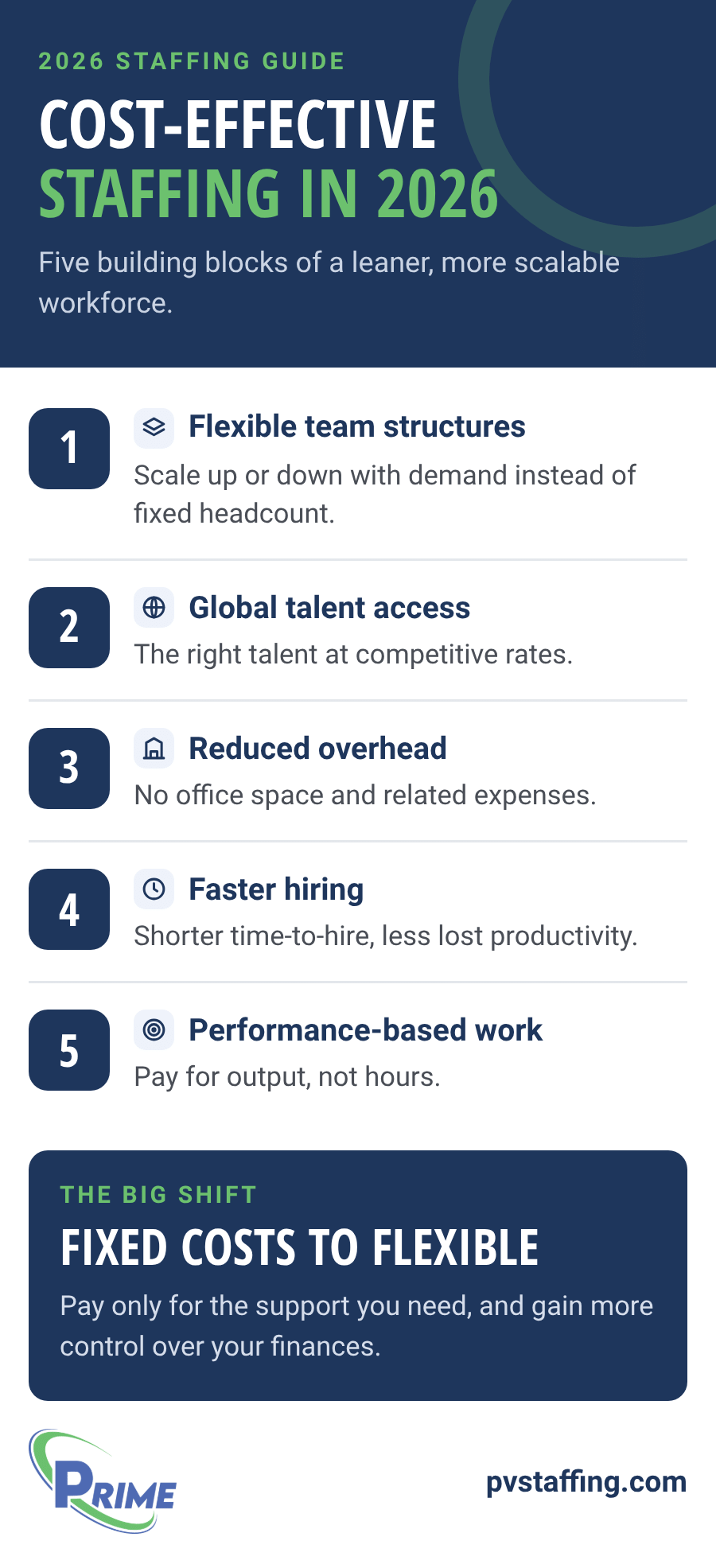
1. Flexible Team Structures
Instead of fixed, full-time teams, businesses are adopting flexible structures that can scale up or down based on demand. This reduces unnecessary labor costs while maintaining productivity.
2. Global Talent Access
Hiring globally allows businesses to find the right talent at competitive rates. It also improves diversity, innovation, and overall team performance.
3. Reduced Overhead Costs
Eliminating the need for physical office space and related expenses significantly lowers operational costs.
4. Faster Hiring Processes
Efficient recruitment systems reduce time-to-hire, minimizing downtime and lost productivity.
5. Performance-Based Work Models
Focusing on output rather than hours worked ensures that businesses get maximum value from their workforce.
Virtual Staffing as a Cost-Efficiency Driver
Virtual staffing is one of the most effective ways to implement a cost-efficient workforce strategy.
By removing geographic limitations and reducing overhead, businesses can allocate resources more strategically. This allows companies to reinvest savings into growth initiatives such as marketing, technology, and expansion.
Learn how our remote teams help businesses achieve greater efficiency while maintaining high performance.
Comparing Cost: Traditional vs Virtual Staffing
The difference between traditional hiring and virtual staffing becomes clear when comparing total costs.
Traditional hiring includes fixed expenses such as office space, utilities, and long-term salaries. Virtual staffing, on the other hand, offers a more flexible cost structure where businesses only pay for the support they need.
This shift from fixed to variable costs improves financial control and reduces risk.
Long-Term ROI of Cost-Effective Staffing
Cost-effective staffing is not just about immediate savings. It creates long-term value.
Businesses benefit from improved scalability, reduced financial risk, and the ability to adapt quickly to changing market conditions.
According to Harvard Business Review, organizations that adopt flexible workforce strategies often outperform competitors in both efficiency and growth.
Common Mistakes to Avoid
Many businesses attempt to reduce costs in ways that negatively impact performance. Common mistakes include underinvesting in talent, prioritizing cost over quality, and failing to implement proper systems and processes.
Cost-effective staffing should focus on optimization, not reduction.
Building Your Cost-Effective Staffing Plan
To create a successful strategy, businesses should evaluate their current workforce model, identify inefficiencies, and explore more flexible alternatives.
Start by assessing which roles can be transitioned to remote or virtual support. Then, implement scalable staffing solutions that align with your long-term business goals.
Explore more insights and strategies on our blog to guide your workforce transformation.
_______________________
The future of staffing is flexible, scalable, and cost-efficient.
Businesses that continue to rely solely on traditional hiring models risk falling behind in a rapidly evolving market. Those that embrace smarter staffing strategies gain a competitive advantage through improved efficiency, reduced costs, and stronger performance.
Cost-effective staffing is not just a trend. It is a necessity for sustainable growth in 2026 and beyond.
If you are ready to optimize your workforce and reduce operational costs, now is the time to take action.
Learn more about PV Staffing, explore our services, or connect with our team through the contact page.
Build a smarter, more efficient team and position your business for long-term success.
Related Reading
- Virtual Staffing vs Traditional Hiring: A Cost Breakdown
- The ROI of Virtual Teams: What Every Business Should Know
- Why Smart Businesses Are Replacing Traditional Hiring with Virtual Staffing
Ready to see what virtual staffing could do for your business? Schedule a free, no-obligation consultation with our team and get a clear plan for which roles to hand off first. Book your free consultation