Hiring a virtual staffing company can be one of the best moves you make for your business. The right partner gives you skilled, dedicated people who take work off your plate from day one. The wrong one gives you a revolving door of underprepared hires, missed deadlines, and more management work than you started with.
The problem is that from the outside, most staffing companies look the same. Similar websites, similar promises, similar price ranges. The difference shows up three months in — when someone quits, a client complaint lands, or you realize nobody is actually checking the work.
Before you sign anything, ask these eight questions. The answers will tell you whether you’re getting a real partner or just a placement.
The 8 Questions to Ask
1. How do you recruit and screen candidates?
This is where quality starts. Ask what the process looks like from application to placement.
What a good answer sounds like:
- Multiple interview rounds, not a single call
- Skills testing that matches the actual role (writing samples, typing tests, software tests, mock customer calls)
- English communication assessment
- Background and reference checks
- A clear acceptance rate — strong firms turn away most applicants
Red flag: “We have a large talent pool you can browse.” That usually means you’re doing the screening yourself.
2. Will my team member be dedicated to my business?
Some providers assign one assistant to several clients at once. That can work for light, occasional tasks, but it rarely works for core operations. Your assistant ends up juggling priorities you can’t see.
Ask directly: Is this person full-time and dedicated to my account, or shared? If shared, ask how many clients they support and how urgent requests are prioritized.
3. Who manages the day-to-day — me or you?
This is the question most business owners forget to ask, and it’s the one that matters most once the honeymoon period ends.
A pure placement service hands you a person and steps away. A managed staffing partner stays involved with:
- Ongoing check-ins and performance reviews
- Attendance and productivity tracking
- Coaching when performance slips
- A point of contact you can call when something isn’t working
If you don’t have time to manage someone closely, a managed model is worth paying for. (We break down the trade-offs in Virtual Employee vs. Freelancer: Which Is Right for Your Business?)
4. What happens if it’s not the right fit?
Even with great screening, not every placement works. What matters is how fast the problem gets fixed.
Ask about:
- Replacement guarantees — Is there a no-cost replacement if the fit isn’t right?
- Timeline — How quickly can they present new candidates?
- Knowledge transfer — Will they help document processes so a new hire isn’t starting from zero?
A partner that’s confident in its process will have clear, written answers here.
5. How do you handle data security and confidentiality?
Your virtual team will likely touch client information, financials, or internal systems. Ask how the provider protects it.
Look for:
- Signed NDAs and confidentiality agreements for every team member
- Secure workstation and internet requirements
- Guidance on access control (password managers, role-based permissions, no shared logins)
- A plan for removing access quickly when someone leaves
For a deeper checklist, see our guide on how to ensure data security when working with a virtual team.
6. How are your team members employed and supported?
This one seems like it’s not your problem — but it is. People who are paid fairly, receive proper benefits, and feel supported by their employer stay longer and perform better. High turnover at your provider becomes high turnover on your account.
Ask whether team members are employees or independent contractors, what benefits they receive, and what the provider does to retain good people. Low turnover is one of the most underrated signs of a good staffing partner. (More on that in Cutting Employee Turnover Costs with Virtual Staffing.)
7. What does onboarding look like in the first 30 days?
A strong start prevents most problems. Ask the provider to walk you through how a new team member gets up to speed on your business.
Good signs:
- A kickoff call to define priorities, tools, and communication expectations
- Help documenting your processes into simple SOPs
- Scheduled check-ins at 1, 2, and 4 weeks
- Clear early wins defined up front, so you can see value fast
Red flag: “They’ll figure it out.” Nobody figures out your business without guidance.
8. What’s included in the price — and what isn’t?
Hourly rates are easy to compare. Total value isn’t. Get clarity on:
- Is the rate all-inclusive, or are there setup, recruiting, or management fees?
- Are there minimum contract terms?
- How are holidays, sick days, and time off covered?
- What does it cost to add a second or third team member later?
The cheapest option often becomes the most expensive once you factor in turnover, rehiring time, and your own hours spent managing.
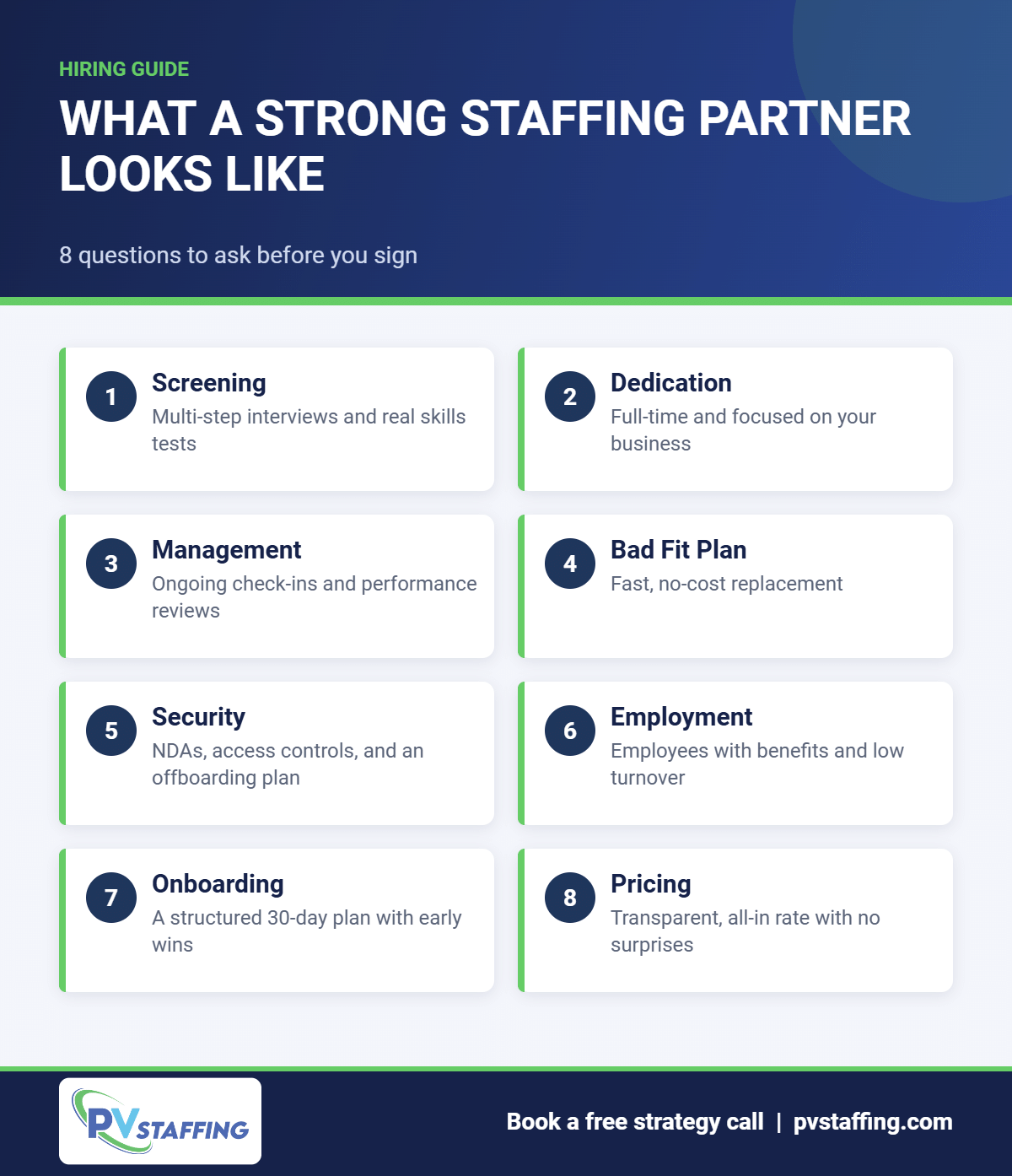
Quick Comparison: What to Look For
| Question | Strong partner | Warning sign |
|---|---|---|
| Screening | Multi-step interviews and skills tests | “Browse our talent pool” |
| Dedication | Full-time, dedicated to you | Shared across many clients |
| Management | Ongoing support and reviews | Hands-off after placement |
| Bad fit | Fast, no-cost replacement | Start over and pay again |
| Security | NDAs, access controls, offboarding plan | No clear policy |
| Employment | Employees with benefits, low turnover | Gig contractors, high churn |
| Onboarding | Structured 30-day plan | “They’ll figure it out” |
| Pricing | Transparent, all-in rate | Hidden fees and add-ons |
Frequently Asked Questions
How long does it take to get a virtual team member placed?
It varies by role and provider, but a well-run staffing company can usually present qualified candidates within a few weeks. Ask for a typical timeline up front.
Should I hire one person or start with a small team?
Most businesses start with one dedicated team member in their biggest bottleneck — usually admin, customer service, or bookkeeping support — then add roles once processes are documented.
Can I interview candidates myself?
You should be able to. A good partner pre-screens and then lets you make the final call. Our guide on how to interview and select the best virtual employee covers what to ask.
The Bottom Line
The right virtual staffing partner doesn’t just fill a seat — they help you build a team that sticks. Use these eight questions on every provider you talk to, including us.
Ready to see how Prime Virtual Staffing answers them? Schedule a free strategy call and we’ll walk you through our process, start to finish.