Hiring decisions have a direct impact on a company’s financial health. For many businesses, traditional hiring has long been the standard approach. However, as operating costs continue to rise and market conditions shift, leaders are reevaluating whether this model is still the most efficient option.
Virtual staffing has emerged as a powerful alternative, offering businesses the ability to reduce costs while maintaining productivity and performance. Businesses exploring this model can learn more about our virtual staffing services and how flexible workforce structures support cost efficiency.
According to the World Economic Forum, organizations adopting flexible workforce strategies are better positioned for long-term financial resilience. Understanding the true cost difference between these two models is essential for making smarter workforce decisions.
The True Cost of Traditional Hiring
Traditional hiring involves more than just salaries. While compensation is a significant factor, it is only one part of a much larger financial picture.
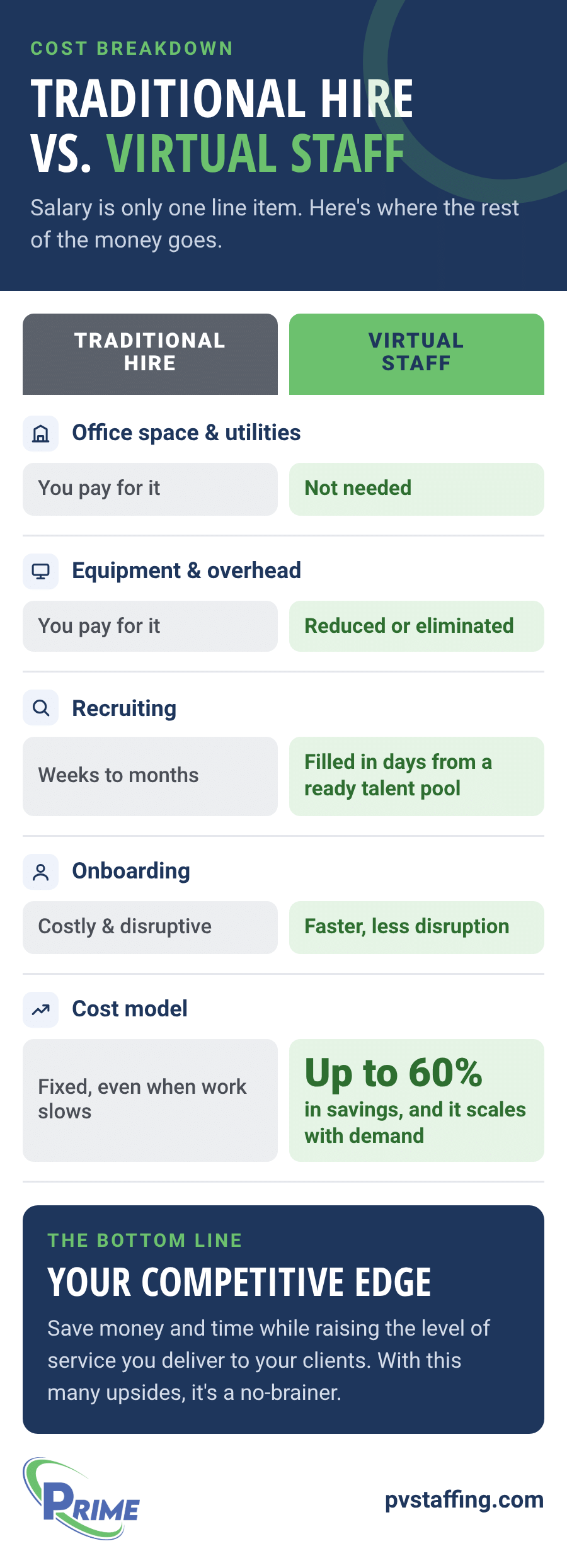
Businesses must account for office space, equipment, utilities, benefits, taxes, and onboarding expenses. Recruitment itself can be costly and time-consuming, often requiring weeks or months to find the right candidate.
In addition, fixed costs remain constant regardless of workload. Whether business demand is high or low, organizations are responsible for maintaining these expenses, which can limit flexibility and increase financial risk. Research from Gartner highlights how rigid workforce models can reduce organizational agility and increase operational costs over time.
The Cost Structure of Virtual Staffing
Virtual staffing shifts the cost model from fixed to flexible. Instead of investing heavily in infrastructure and long-term commitments, businesses pay for the support they need based on their operational requirements.
There is no need for additional office space, and many overhead costs are significantly reduced or eliminated. Hiring timelines are typically shorter, allowing businesses to fill roles faster and respond quickly to changing demands.
This streamlined cost structure allows organizations to allocate resources more strategically, focusing on growth initiatives rather than maintaining operational overhead. Many companies achieve this through structured remote staffing solutions that align talent with real-time business needs.
Comparing Overhead Expenses
One of the most noticeable differences between traditional hiring and virtual staffing is overhead.
Traditional teams require physical space, equipment, maintenance, and ongoing operational support. These costs can add up quickly, especially as a business scales.
Virtual teams operate without these constraints. By removing location-based expenses, businesses can significantly reduce overhead while maintaining productivity. This creates a leaner operational model that is better suited for growth.
Recruitment and Onboarding Costs
Hiring locally often involves extended recruitment cycles, multiple interviews, and onboarding processes that require time and resources. Delays in hiring can slow down operations and impact revenue.
Virtual staffing simplifies this process. With access to a broader talent pool and more efficient recruitment systems, businesses can onboard professionals faster and with less disruption.
Reduced hiring time translates directly into cost savings and improved operational continuity. Insights from McKinsey show that faster talent deployment significantly improves business responsiveness and productivity.
Flexibility and Financial Efficiency
Flexibility is a key driver of cost efficiency. Traditional hiring models are built around long-term commitments, which can become costly if business needs change.
Virtual staffing allows organizations to adjust team size and support levels based on current demand. This adaptability helps businesses avoid unnecessary expenses while maintaining the ability to scale when needed.
Financial efficiency is not just about spending less. It is about spending smarter.
Productivity and Return on Investment
Cost savings are important, but they must be balanced with performance. A lower-cost workforce is only valuable if it maintains or improves productivity.
Virtual staffing enables businesses to focus on output and results. By aligning roles with specific tasks and responsibilities, organizations often see improved efficiency and stronger performance outcomes.
When productivity increases while costs decrease, the return on investment becomes significantly higher. Studies from Harvard Business Review emphasize that outcome-based workforce models often outperform traditional structures in both efficiency and performance.
Long-Term Financial Impact
Over time, the difference between traditional hiring and virtual staffing becomes more pronounced. Fixed overhead, slower hiring processes, and limited flexibility can restrict long-term growth.
In contrast, virtual staffing supports a more sustainable financial model. Businesses can reinvest savings into innovation, technology, and strategic initiatives that drive future success.
This long-term perspective is what makes virtual staffing an attractive option for forward-thinking organizations.
The comparison between virtual staffing and traditional hiring goes beyond simple cost reduction. It reflects a shift in how businesses approach growth, efficiency, and workforce design.
Traditional hiring offers stability but often comes with higher costs and less flexibility. Virtual staffing provides a more adaptable and cost-efficient alternative that supports modern business needs.
For companies looking to optimize their operations and maximize return on investment, understanding this cost breakdown is the first step toward making smarter, more strategic decisions.
If you are evaluating your current hiring strategy, now is the time to explore a more efficient approach. Learn more about our full range of services, explore additional insights on our blog, or connect with our team through the contact page.
Virtual staffing can help you reduce costs, improve flexibility, and build a workforce designed for growth. The right model does not just support your business today. It positions you for long-term success.
Related Reading
- The ROI of Virtual Teams: What Every Business Should Know
- The Complete Guide to Cost-Effective Staffing in 2026
- The New Hiring Advantage: Speed, Skill, and Flexibility
Ready to see what virtual staffing could do for your business? Schedule a free, no-obligation consultation with our team and get a clear plan for which roles to hand off first. Book your free consultation