For a lot of business owners, the books are a source of low-grade stress. Receipts pile up. Invoices go out late. Bank reconciliations happen once a quarter, right before the accountant asks for them. And every month-end feels like a scramble.
The fix usually isn’t a bigger accounting firm. It’s getting the day-to-day financial admin handled consistently, so your books are clean and your CPA can focus on the high-value work you’re actually paying them for.
That’s where a virtual bookkeeping assistant comes in.
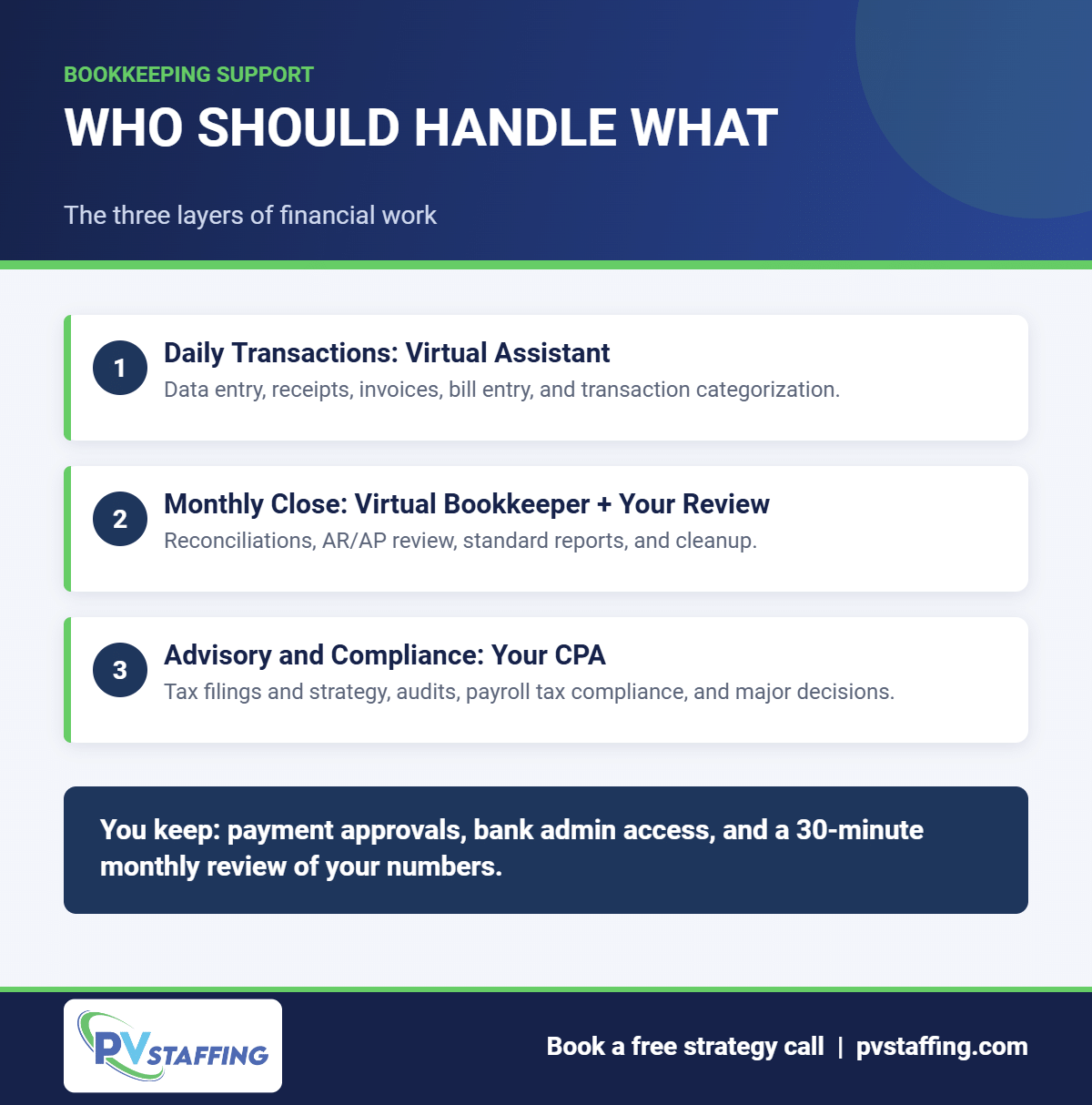
The Three Layers of Financial Work
It helps to think about your finances in three layers. Each one needs a different level of skill — and has a very different cost.
| Layer | What it includes | Who should do it |
|---|---|---|
| Daily transactions | Data entry, receipts, invoices, bill entry, categorization | Virtual bookkeeping assistant |
| Monthly close | Reconciliations, AR/AP review, reports, cleanup | Virtual bookkeeper with your oversight |
| Advisory and compliance | Tax filings, tax strategy, audits, financial planning, entity decisions | Your CPA or accountant |
The problem in most small businesses is that the bottom layer gets done by the owner (slowly) or by the CPA (expensively). Moving it to a dedicated virtual assistant fixes both.
What to Hand Off to a Virtual Bookkeeping Assistant
Accounts Payable
- Entering bills and vendor invoices
- Matching invoices to purchase orders
- Preparing payment batches for your approval
- Tracking due dates so nothing gets paid late
Accounts Receivable
- Creating and sending customer invoices
- Sending payment reminders on a consistent schedule
- Logging payments and updating customer accounts
- Flagging past-due accounts for follow-up
Daily Bookkeeping
- Categorizing bank and credit card transactions
- Collecting and attaching receipts
- Keeping vendor and customer records clean
- Organizing documents in a shared folder your accountant can access
Month-End Support
- Bank and credit card reconciliations
- Preparing standard reports (P&L, balance sheet, AR aging) for review
- Pulling together the documents your CPA requests
A trained virtual assistant can do all of this inside the tools you already use — QuickBooks Online, Xero, Bill.com, and similar platforms.
What Your CPA Should Keep
A virtual bookkeeping assistant supports your accounting function. It doesn’t replace professional advice. Keep these with a licensed accountant:
- Tax preparation and filing
- Tax planning and strategy
- Payroll tax compliance
- Audit and review work
- Major financial decisions, entity structure, and financing
The result is a cleaner split: your CPA spends less time cleaning up and more time advising, which often lowers what you pay them for cleanup work.
What to Keep In-House
Some controls should stay with you or a trusted manager, no matter who does the bookkeeping:
- Approving and releasing payments. Your VA prepares; you approve.
- Bank account ownership and admin access. Give your VA view or limited access only.
- Reviewing monthly reports. Spend 30 minutes a month reading your numbers.
These simple separation-of-duties steps protect your business and make the arrangement work long term.
Setting It Up Securely
Financial access requires extra care. A few basics go a long way:
- Use role-based user access in your accounting software — never share your login
- Use a password manager for any shared credentials
- Keep approval authority for payments with the owner or controller
- Require NDAs and confidentiality agreements
- Review user access quarterly
For more, see our guide to data security when working with a virtual team.
Signs It’s Time for Bookkeeping Support
- You’re more than a month behind on reconciliations
- Invoices go out late or inconsistently
- You’ve paid a bill twice, or missed one
- Your CPA charges cleanup fees at tax time
- You don’t know your actual cash position without logging in to three accounts
If any of these sound familiar, consistent daily support will make a bigger difference than another tool or another late night.
Frequently Asked Questions
Is a virtual bookkeeping assistant the same as an outsourced accounting firm?
No. An accounting firm provides professional services and advice. A virtual bookkeeping assistant is a dedicated team member who handles your day-to-day financial admin under your direction, alongside your accountant.
Can a virtual assistant work with my existing CPA?
Yes — and that’s the ideal setup. Your VA keeps the books clean and organized so your CPA has what they need without chasing it.
How many hours of bookkeeping support do I need?
It depends on transaction volume. Many small businesses start with part of a role focused on AP, AR, and reconciliations, then expand into broader admin support.
Get Your Books Off Your Plate
Prime Virtual Staffing provides trained accounting support team members who work in your systems, under your controls. Schedule a free strategy call and we’ll help you map out which financial tasks to hand off first.