Ask most contractors what they’ve outsourced, and the answer is usually the same: bookkeeping. Maybe payroll.
But accounting is just one piece of the construction back office. The paperwork that actually slows jobs down — submittals, permits, subcontractor compliance, scheduling, bid follow-up — usually lands on project managers and owners who should be in the field or out selling work.
Those tasks are document-driven, process-heavy, and done mostly on a computer and phone. That makes them a great fit for trained virtual staff.
Here are 10 construction back-office roles, beyond accounting, that work well virtually.
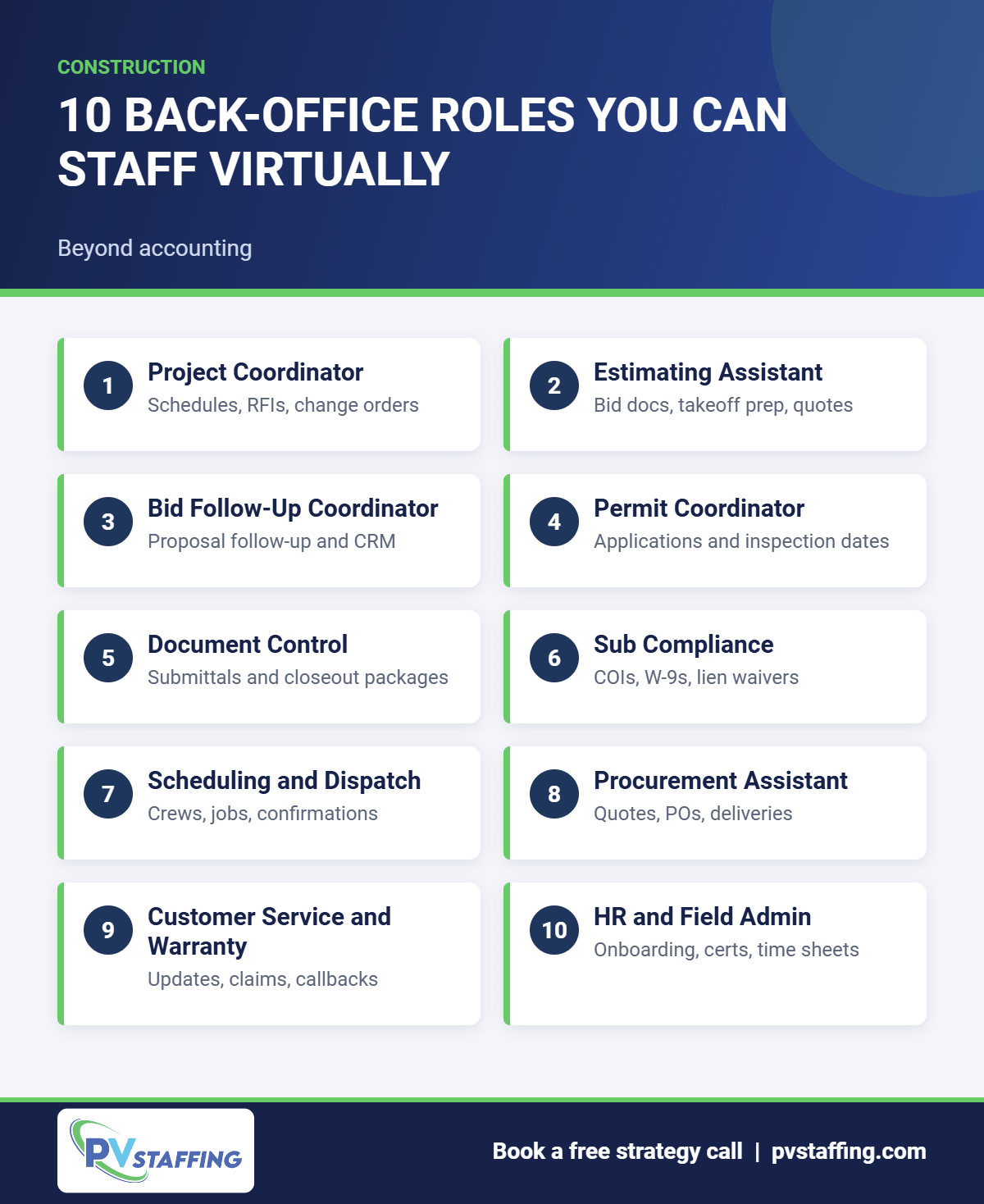
10 Back-Office Roles That Work Well Virtually
1. Project Coordinator
Your project managers shouldn’t be spending their days updating schedules and chasing emails. A virtual project coordinator can:
- Maintain project schedules and update timelines
- Track RFIs, change orders, and open items
- Send meeting notes and action items
- Keep project folders organized in Procore, Buildertrend, or your project management system
Impact: PMs spend more time on site and less time on admin.
2. Estimating Assistant
Estimators are expensive and hard to find. An estimating assistant handles the prep work so your estimator can focus on pricing.
- Downloading and organizing bid documents and plans
- Building takeoff templates and organizing quantities for review
- Requesting and tracking subcontractor and supplier quotes
- Logging bid due dates and pre-bid meetings
Impact: Your team can bid more work without adding another senior estimator.
3. Bid and Sales Follow-Up Coordinator
Plenty of contractors lose jobs simply because nobody followed up. A virtual coordinator can:
- Follow up on submitted bids and proposals
- Update your CRM with status and next steps
- Monitor bid boards and invitation-to-bid emails
- Schedule site visits and estimate appointments
4. Permit Coordinator
Permitting is slow, detailed, and different in every jurisdiction. A virtual permit coordinator can prepare applications, track submission status, respond to routine comments, and keep a calendar of inspection dates.
5. Submittal and Document Control Specialist
Submittals, closeout packages, O&M manuals, and warranty documents pile up fast. A document control specialist keeps everything organized, tracked, and ready when the owner or GC asks for it.
6. Subcontractor Compliance Coordinator
Missing paperwork creates real risk. A compliance coordinator can:
- Collect and track certificates of insurance (COIs) and expiration dates
- Collect W-9s, licenses, and signed subcontract agreements
- Track lien waivers with each pay application
- Flag missing or expired documents before payments are released
Impact: Cleaner files, fewer payment delays, and less exposure.
7. Scheduling and Dispatch Coordinator
For contractors running crews or service techs, scheduling is a full-time job. A virtual dispatcher can book jobs, coordinate crews, confirm appointments with customers, and update the schedule when things change — which they always do.
8. Procurement and Purchase Order Assistant
Material delays stall jobs. A procurement assistant can request quotes, create purchase orders, track deliveries, and confirm lead times with suppliers, so your PMs aren’t chasing orders.
9. Customer Service and Warranty Coordinator
Homeowners and clients want updates. A virtual coordinator can answer calls, provide project status updates, log warranty claims, and schedule callback visits — keeping clients happy without pulling your PMs off the job.
10. HR and Field Admin Support
Construction has heavy HR paperwork. A virtual admin can handle new-hire paperwork, track certifications and safety training, manage time sheet collection, and organize field documentation.
Which Roles to Start With
| If your biggest pain is… | Start with |
|---|---|
| PMs buried in admin | Project Coordinator |
| Not bidding enough work | Estimating Assistant + Bid Follow-Up |
| Payment delays and missing docs | Subcontractor Compliance Coordinator |
| Scheduling chaos | Scheduling and Dispatch Coordinator |
| Unhappy or uninformed clients | Customer Service and Warranty Coordinator |
Many contractors start with one versatile project admin who covers coordination and compliance, then split into specialized roles as volume grows.
What Stays in the Field
Virtual staff handle the office side. Keep these with your on-site and licensed team:
- Site supervision, safety, and quality control
- Final pricing and bid decisions
- Contract negotiations and change order approvals
- Inspections and walk-throughs
Frequently Asked Questions
Do virtual staff need construction experience?
Experience helps, especially for estimating and project coordination. For admin, compliance, and dispatch roles, strong organization and clear processes matter more — industry terms can be learned quickly.
What software can a virtual team member use?
Most construction software is cloud-based, including Procore, Buildertrend, and QuickBooks, so virtual staff can work in your systems with their own user access.
Can virtual staff cover early mornings when crews start?
Yes. Virtual team members can be scheduled to match your hours, including early starts for dispatch and scheduling.
Build a Back Office That Keeps Up With Your Crews
Prime Virtual Staffing helps construction companies build reliable back-office teams that keep jobs moving. Schedule a free strategy call and we’ll help you identify the role that will free up your team the fastest.