For years, offshoring was something only large corporations did. They had the budget for overseas offices, the legal teams, and the HR infrastructure to make it work.
That’s changed. Today, small and mid-sized businesses can build a dedicated overseas back office through a staffing partner — no foreign entity, no international payroll headaches, no office lease.
Done well, it’s one of the highest-return operational moves a growing business can make. Done poorly, it creates frustration on both sides. Here’s what you need to know.
What Is a Back Office?
Your back office is everything that keeps the business running but doesn’t directly face the customer in person:
- Administrative support and data entry
- Bookkeeping, AP, and AR
- Customer service by phone, email, and chat
- Scheduling and dispatch
- Order processing and inventory updates
- Sales support, lead follow-up, and CRM management
- Document management and compliance tracking
- Marketing support and social media
If a task is done on a computer and follows a repeatable process, it can usually be done from anywhere.
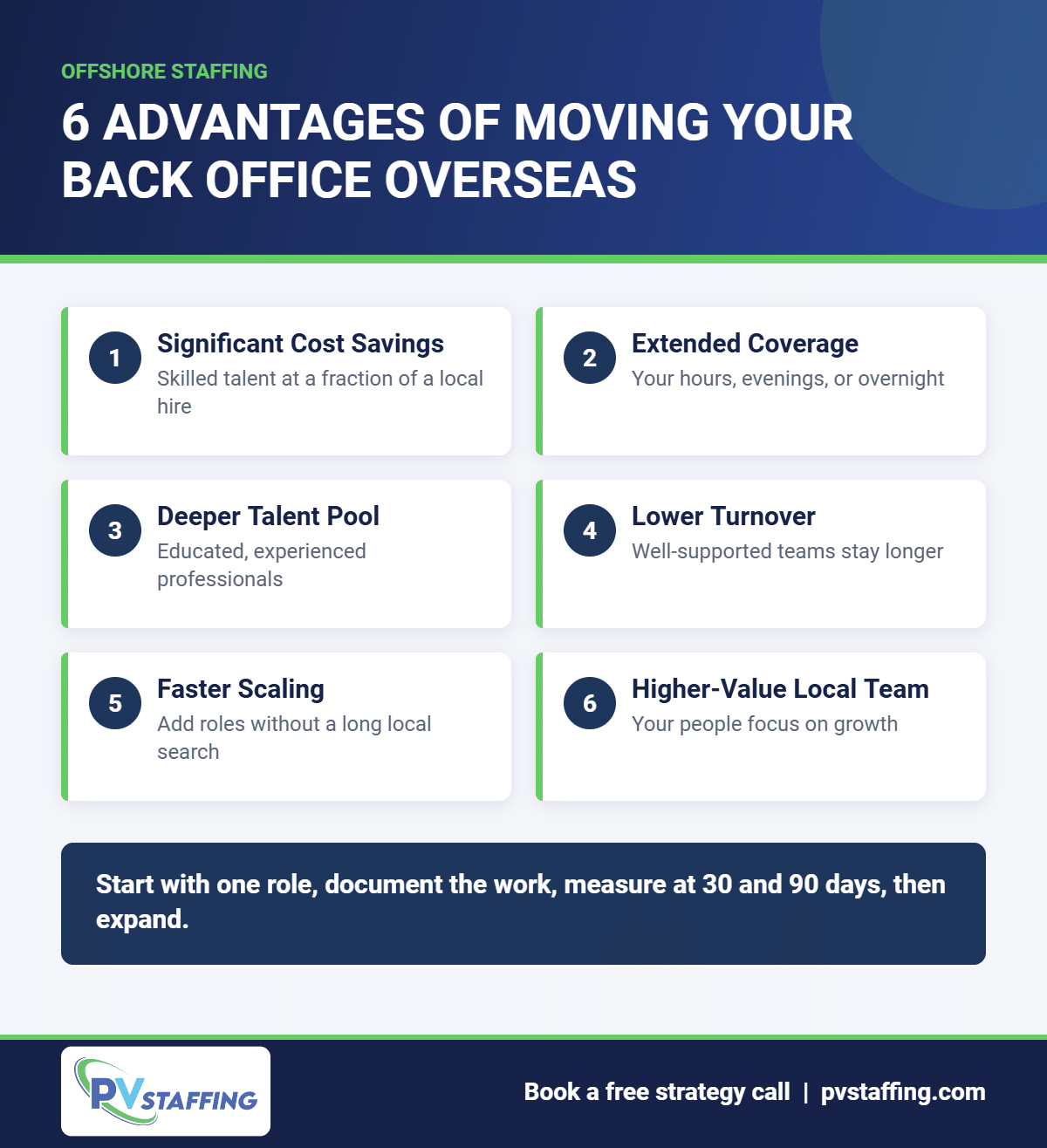
The Advantages of Moving Your Back Office Overseas
1. Significant Cost Savings
This is the most obvious benefit. Skilled professionals in markets like the Philippines can do the same work as a local hire at a fraction of the fully loaded cost — without US-level salary, benefits, payroll taxes, office space, or equipment on your books.
Those savings don’t have to come from cutting people. Many businesses use them to add capacity they couldn’t otherwise afford. (We run the numbers in Virtual Staffing vs. Traditional Hiring: A Cost Breakdown.)
2. Extended Coverage Hours
An overseas team doesn’t have to work your hours — or it can work exactly your hours. That flexibility lets you:
- Cover your full US business day
- Add evening or overnight coverage for customer service
- Have work completed overnight so it’s ready when you start your day
3. Access to a Deeper Talent Pool
Local hiring markets for admin, customer service, and bookkeeping roles are competitive and expensive. Going global opens up a much larger pool of educated, experienced professionals. The Philippines in particular has a deep, well-established outsourcing workforce with strong English skills and familiarity with US business culture.
4. Lower Turnover
When overseas team members are employed well — fair pay, benefits, and real support — retention can be excellent. Steady teams mean less retraining and better institutional knowledge.
5. Faster Scaling
Need two more people for busy season? A staffing partner with an established recruiting pipeline can typically fill roles faster than a local job posting, without you managing the hiring process.
6. Your Local Team Focuses on Higher-Value Work
The biggest benefit is often overlooked. When repetitive work moves offshore, your local team can focus on sales, client relationships, and leadership — the work that actually grows revenue.
What to Get Right
Offshoring fails for predictable reasons. Here’s how to avoid them.
| Common mistake | What to do instead |
|---|---|
| Hiring the cheapest freelancer you can find | Work with a managed staffing partner that screens, trains, and supports the team |
| No documented processes | Start with simple SOPs and screen recordings for each task |
| Unclear expectations | Define KPIs, response times, and working hours from day one |
| Treating offshore staff as outsiders | Include them in team meetings, tools, and communication channels |
| Weak security practices | Use role-based access, password managers, and NDAs |
| Moving everything at once | Start with one or two roles, prove it works, then expand |
Communication Is Everything
Time zones and distance aren’t the real challenge — unclear communication is. Set up:
- A shared chat channel for quick questions
- A daily or weekly check-in
- A single task management system
- Clear escalation rules for urgent issues
Our post on 8 remote team management mistakes covers this in more detail.
Employment and Compliance
Make sure your overseas team is employed properly in their home country. Working with a staffing partner that handles local employment, payroll, and required benefits protects you and helps keep good people. (More on that in The Benefits of Hiring Remote Filipino Workers Through Companies With Statutory Benefits.)
A Simple Rollout Plan
- Identify your top three back-office bottlenecks. Where do tasks pile up?
- Choose one role to start. Usually admin, customer service, or bookkeeping support.
- Document the work. Record yourself doing each task once.
- Onboard with structure. Daily check-ins for the first two weeks, then weekly.
- Measure results at 30 and 90 days. Response times, task completion, hours saved.
- Expand. Add the next role once the first one is running smoothly.
Frequently Asked Questions
Will my customers notice the difference?
With proper training, scripts, and quality checks, customers experience the same professional service. Many businesses see faster response times after moving support to a dedicated team.
How do I handle the time difference?
Overseas team members commonly work US business hours. You decide the schedule based on your needs.
Is my data safe with an overseas team?
Security depends on your processes, not your team’s location. Use the same access controls you’d use with any employee: individual logins, role-based permissions, and NDAs.
Build Your Global Back Office the Right Way
Prime Virtual Staffing helps businesses move back-office work to dedicated, well-supported overseas team members — with recruiting, management, and support included. Schedule a free strategy call to see which roles make sense to move first.